Aligners
Up to 200 / kg
~€3.00
per print
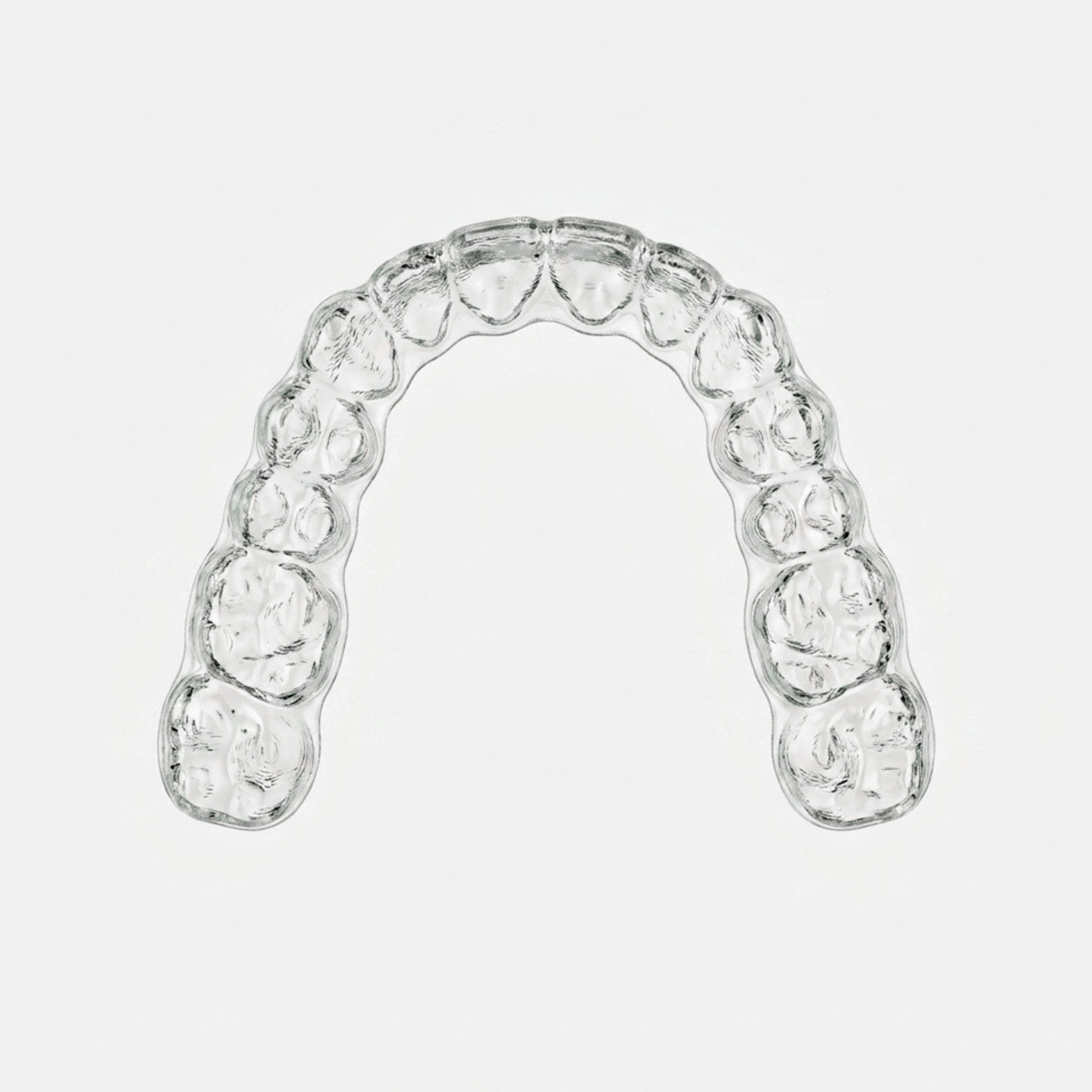
Direct-printed transparent aligners for digitally driven orthodontic treatment.


The field of dental appliance fabrication is undergoing a remarkable transformation with the integration of shape-memory polymers (SMPs) and advanced direct 3D printing technology. These innovations have already begun to modernise clear aligner therapy, and they also offer clear advantages for retainers, splints and other custom-made appliances.
This article shows how they work, what the research says so far, and where ClearShape Resin fits in.
Thermoformed aligners and retainers are still the standard, but their material and production method set clear limits.
Shape-memory polymers (SMPs) can "remember" a programmed shape. They can be deformed when warm, hold that shape once cooled, and move back toward their original shape when heated again. In aligners, this behaviour is designed to deliver gentle, sustained force.
In vitro studies suggest that SMP aligners deliver forces within the orthodontic range,[²] and that heat can partially restore force after it has declined.[³]
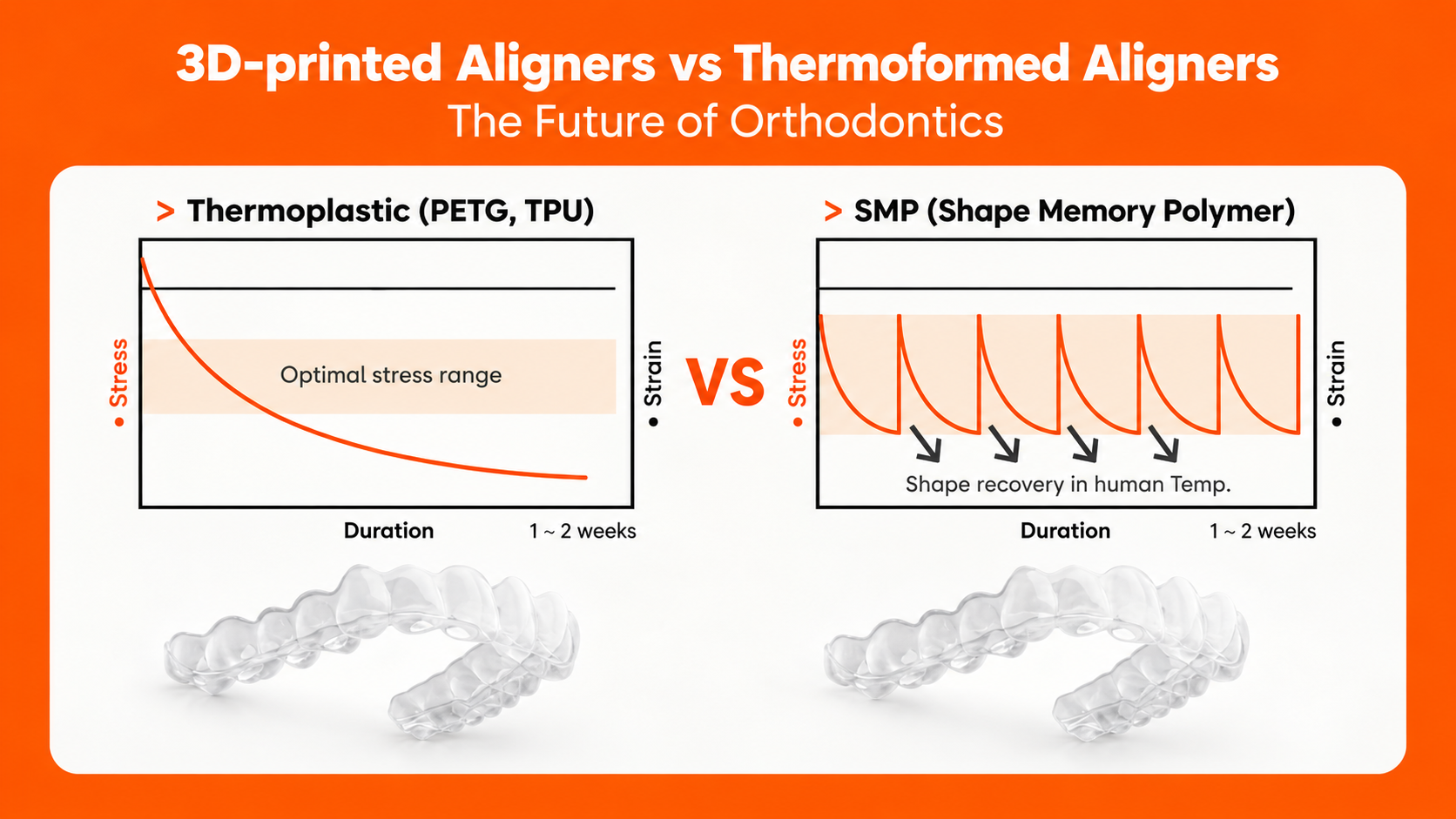
For clear aligners, shape-memory behaviour may help deliver more sustained and controlled orthodontic forces. A review of in vitro work on SMP aligners reports forces of roughly 0.7 to 1.7 N.[⁴]
Shape-memory polymers also offer advantages for maintaining tooth position after treatment.
The ability to reset the polymer’s shape with heat means that SMP retainers can recover their original programmed shape without immediately requiring an entirely new device.
This adaptability can support long-term retention and patient compliance. The retainer can be refreshed in the dental practice or at home, helping maintain its fit and function over time.
Splints and custom-made (sleep appliances require a precise fit and controlled flexibility to support therapeutic goals such as jaw stabilisation or airway management.
SMP materials allow these appliances to maintain their shape and mechanical properties under varying oral conditions. Their ability to be reset also gives clinicians greater flexibility to fine-tune an appliance as treatment progresses.
This can reduce the need for remakes while improving patient comfort.
Unlike thermoforming, direct 3D printing builds the appliance straight from the digital design. This avoids the distortion that can occur when a sheet is vacuum-formed over a physical model.
The printed shape can follow fine anatomical detail, including interproximal and other undercuts. A closer fit may improve mechanical retention and reduce the need for attachments or auxiliary retention features.
Because every aspect of the appliance is designed digitally, clinicians and dental technicians can create shapes and functional features that are difficult or impossible to produce using traditional laboratory techniques.
This opens new possibilities for appliance design, biomechanics, and patient-specific functionality.
Because the appliance is designed digitally, features can be built into the design itself, such as force ridges, pressure zones and variations in thickness.
These features may help with movements that are difficult for aligners, including:
Printed retainers can also be adapted closely to the dental arch, which may support retention and comfort.
Splints need a precise fit and the right balance between rigidity and flexibility. Direct 3D printing gives control over thickness, flexibility and anatomical fit, which matters for applications such as jaw stabilisation.
It also simplifies production. A digital workflow replaces model printing, heating and vacuum-forming, which can shorten turnaround times and make output more consistent. Post-processing such as washing and curing remains part of the process.
One of the most practical benefits of direct 3D printing is the ability to manufacture appliances in small batches, tailored to each treatment stage or patient need.
.jpg)
This makes it easier to adapt treatment to the individual patient and may reduce the need for refinements in clear aligner cases.
Shape-memory polymers and direct 3D printing address different limits of thermoformed appliances. SMPs add a programmed shape that can be recovered with heat, and in vitro studies show forces within the orthodontic range. Direct printing adds a closer fit, design control and a more digital workflow.
Together, they make it possible to produce clear aligners, retainers and splints that are easier to adapt during treatment. Clinical evidence is still developing, but the technology is already available in a practical material form.
Shape-memory polymers are no longer limited to research. They are now being used to create practical dental materials for digital workflows.
ClearShape is Sweeth's biocompatible shape-memory resin for the direct 3D printing of clear aligners, retainers and splints. It combines the design freedom of direct printing with shape-memory behaviour: when heated, an appliance can recover its programmed shape.
Using one resin for aligners, retainers, and splints can simplify material management and reduce the need to stock multiple application-specific resins.
Direct-printed transparent aligners for digitally driven orthodontic treatment.

Direct 3D-printed retainers designed for precise, reliable clinical performance.

Direct-printed transparent splints engineered for durable, consistent performance.
Estimated yield and cost per print based on a €600, 1 kg bottle. Actual results may vary depending on appliance design, thickness, printer settings and production waste.
Direct printing removes the need for physical models and thermoforming. Washing and curing still apply. Small-batch production allows appliances to be made when needed, which may help reduce excess production, material use and inventory complexity.
Explore ClearShape Resin and its production possibilities.
ClearShape has a heat-activated material response. When exposed to the appropriate temperature, an appliance can recover its programmed shape.
ClearShape is manufactured in Europe and is CE-marked. Its biocompatibility has been evaluated in accordance with ISO 10993 testing standards, including assessments for:
The test results support its intended professional dental use.
ClearShape is designed for compatible open-system resin 3D printers. Validated printer profiles and curing workflows are currently available for selected professional printing and curing systems, with additional workflows continuously being tested.
Because printer settings, calibration and post-processing can affect the final appliance, dental professionals should always use the appropriate printer profile and validated spin-and-cure procedure.
Technical documentation is available on request: Technical Data Sheet, Safety Data Sheet, Workflow Guide, validation documentation and printer profiles.
October 7, 2026
Simon Meas
Industry Insights
Thermoformed aligners can lose force quickly under load. Shape-memory polymers and direct 3D printing aim to provide more controlled force and a closer fit.

Sweeth offers complete 3D printing solutions for dental professionals to design and produce aligners, veneers, and custom dental appliances in-house—streamlining workflows with expert support.